I have found it difficult to understand exactly what JRR Tolkien meant by Subcreation in his essay On Fairy Stories. Indeed, I think that it is probably not possible to produce a coherent account of Subcreation within Tolkien's own (Roman Catholic) theology.
Of course many RC Tolkien commentators have tried to do exactly this - explain how Subcreation works within the official theology of the Catholic church; what I am saying is that I have found all such attempts to be incoherent, hence unconvincing.
The problem (as I see it) is to produce an account of Subcreation that applies to Tolkien's own work and is both genuinely 'sub' and also genuinely 'creation'.
The way I envisage it is in terms of my own understanding of metaphysics - in particular the way that Primary Thinking relates to ultimate and universal reality.
So, there is, first of all, the original act of creation by God.
This original creation can be described by Men, and it can be imagined - but these are essentially secondary and indirect communications, prone to distortion and selectivity - they can't really be distinguished as creations.
But the reality of original creation is directly, universally and continuously accessible to men in the activity of Primary Thinking. When we think in this Primary mode, the thoughts are not 'in our heads' (nor located in our personal minds) - but instead we personally participate in the universal realm of reality; and we think with the same thoughts as were original in creation (however, only a minuscule proportion of such thoughts, and only perceived from our own distinctive and partial perspective).
In this universal realm, all is true and all is wholly Good - because divine. But this realm is not fixed, but rather it is a living, dynamic, and evolving-growing realm; and Men are sometimes able to contribute to it.
We can therefore participate in this realm - initially by knowing it directly, but also potentially (in so far as our thinking is divine) by contributing to it - and this I regard as Subcreation.
So, Subcreation is significant because it is an actual, universal and permanent contribution or addition to the 'content' of the universal realm of creation; which we personally may access by Primary Thinking.
A genuine act of human Subcreation is therefore an act that adds-to the totality of original creation - such that, from then onwards, any Being that is participating in the universal realm may (in principle) be able to discover the content of Subcreation.
So, if Tolkien is regarded as a genuine Subcreator - then his work has not only been present in the world of human communications, but also has affected, permanently, the ultimate and universal world of reality and truth. Such that any person who is participating in that universal realm, and who is mystically in-contact-with God's original creation; may also potentially discover the truth and reality of Tolkien's permanent contribution to that realm.
Whether JRR Tolkien actually attained to this fullness of Subcreation (I judge that he did; but others may disagree) - this is an account of possible Subcreation which is both Sub (to original creation, which came first) and also a genuine act of Creation, when evaluated by the highest and eternal standards.
Showing posts sorted by relevance for query subcreation. Sort by date Show all posts
Showing posts sorted by relevance for query subcreation. Sort by date Show all posts
Monday, 16 October 2017

Thursday, 30 December 2021
Leaf by Niggle and Subcreation
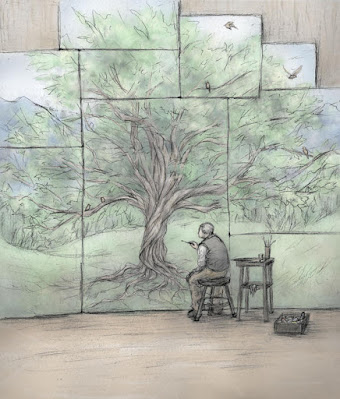
Niggle painting - by ejbeachy
One of Tolkien's most influential concepts was that of Subcreation; which he described in his essay On Fairy Stories as perhaps the most important justification for that genre we now term Fantasy (more exactly High Fantasy - which is characterized by 'world-building').
Subcreation is illustrated in the roughly contemporary short allegorical story Leaf by Niggle, which has usually been printed alongside On Fairy Stories as the volume entitled Tree and Leaf.
Leaf by Niggle is a really delightful, brilliantly-constructed work; which is also revealing of JRR Tolkien's own fears and hopes.
Towards the end of the story, the artist Niggle - having died and been through Purgatory, and with help from his previous neighbour Parish - is able to 'finish' his previously-only-planned Great Painting (allegorically equivalent to the totality of Tolkien's Legendarium); and also to have this painting become really-real (a place called Niggle's Parish) and actually to dwell in its sub-world.
Finally, Niggle passes on from his real-Subcreation towards 'the mountains'; and we hear (from some voices that represent aspects of God) that Niggle's Parish is proving to be very useful for souls emerging from Purgatory as 'a holiday, and a refreshment... for many it is the best introduction to the Mountains'.
Leaf by Niggle neatly encapsulates both the strength and limitations of Tolkien's concept of Subcreation - because on the one hand Subcreation is his justification for serious artistic activity and in particular imaginative and fantasy works...
But on the other hand, in the final analysis; even the most perfect and fully-realized Subcreative work - such as Niggle's Parish - is for Tolkien merely a recreation (holiday/ refreshment/ introduction). For Tolkien it is the Mountains that provide the highest spiritual destination.
My understanding of this is that the Mountains represent contemplation and worship. In other words, in Tolkien's scheme; Man's Subcreation - even at its most ideal - is a lower, temporary and transitional phase of spiritual growth; sooner or later to be set-aside in favour of inactive, immersion in God's creation.
I think that this represents Tolkien's (Roman Catholic, and indeed broadly traditional-Christian) theological view that Man cannot really add-to God's creation. God's creation is complete; and therefore the most any Man's Subcreative activity can do is 'rearrange' aspects of divine creation for particular purposes that have possible value at lower levels of spiritual development.
This seems to be an inevitable consequence of any monotheism in which God is attributed omnipotence and creation ex nihilo ('from nothing').
In a reality in which God already-knows and has-created every-thing, including every-thing about every Man; then there can be no truly original creation. Man's creativity can only be a sub-set of God's, because absolutely everything about Man is of-God.
Therefore, Tolkien's concept of Subcreation gives with one hand, but takes-away with the other; simply because every possible thing a Man might do from-himself is actually just a kind of 'game' played with bits of God's creation.
All possible creative activity by a Man can therefore only be partial and - at best - transitional; a kind of play, a pastime; to pass-time fruitfully en route to the Mountain peaks where all such activity is superseded; and Man becomes a purely-contemplative Being wholly-aligned with God's already-existing creation.
By contrast; my own theological understanding of Christianity is one in which Men live in God's creation, but God's creation is not complete and always developing and expanding; Man is truly free and is a god (of the same Kind as God but much less developed, and only fully divine in Heaven after resurrection).
Indeed, I see this development of Men to become co-creators with God as the primary reason for the original act of divine creation.
For me, therefore, Men are therefore able to add-to God's evolving creation, from their own divine and generative nature - and in a permanent way.
Subcreativity such as Niggle's - and Tolkien's - I therefore regard not as a pastime; but as an ultimately-valid activity; than which nothing is higher - and indeed this divine creativity of Man potentially includes divine procreativity: the begetting of Children of God.
There is only one primary creator, and we live in that reality; but creation is never finished; and it is Man's highest possible aspiration to participate in that creating.
It is the eternal commitment of resurrected Man to live by-Love which aligns all individual creative activity into harmony with the original divine conception.
The extent and nature of each Man's contribution to creation is part of his unique nature. So, although we cannot all be Tolkiens (or even Niggles!) in terms of Subcreative ability; it is the uniqueness of each Man's nature that makes every resurrected individual's creative contribution significant.
Friday, 26 April 2019
Fantasy assists in the evolution of Creation - Tolkien speaks, and then obfuscates...
The respected Inklings scholar David Llewellyn Dodds (who I am lucky to have as a regular commenter here!) has noticed an extremely important phrase that Tolkien devised for the second draft (Manuscript B) of his Essay On Fairy Stories - which is cited on page 247 of Tolkien on Fairy Stories edited by Verlyn Flieger and Douglas A Anderson (2008).
I will give the paragraph leading up to the phrase. Note: There is an opened bracket which is not closed:
But the presence of the Greatest does not (in God's Kingdom depress the small. Redeemed Man is still Man. Stories and Fantasies still go on, should go on. The Gospels have not abrogated Legends: they have hallowed them. As they have not abrogated motherhood, or fatherhood, or supper. Horses have been ennobled by Pegasus: and still may be. For all we know, indeed we may fairly guess, in Fantasy we may actually be assisting in the evolution of Creation.
In Fantasy we may actually be assisting in the evolution of Creation.
This is a clear indication that Tolkien regarded the proper use of imagination - specifically in his own (and other people's) 'subcreation' of Fantasy (such as Fairy Stories) to be a participation in the ongoing divine work of creation.
In other words, Tolkien is saying that subcreation is part of Creation; and this implies that subcreation is not something that merely happens inside people's minds or brains; but that subcreation actually changes 'objective reality' in a permanent fashion.
But of course, Manuscript B of the essay On Fairy Stories is 'only' a draft - and the wording was changed for the final text - as published variously in Essays Presented to Charles Williams (1947), and republished in Tree and Leaf, The Monsters and the Critics and other collections. I will first put the Manuscript B sentence, then the equivalent sentence from the final draft, as given on page 79 of Flieger and Anderson, 2008, ibid:
MS-B: For all we know, indeed we may fairly guess, in Fantasy we may actually be assisting in the evolution of Creation.
FINAL: So great is the bounty with which [Man] has been treated that he may now, perhaps, fairly dare to guess that in Fantasy he may actually assist in the effoliation and multiple enrichment of creation.
Having MS-B in front of us for reference, I think we can see that, Tolkien does not necessarily change the substantive meaning of the sentence - but he does make its meaning much less clear.
Indeed, the final and published version looks rather like obfuscation - a deliberate concealment of meaning! Because it is not at all clear what 'the effoliation and multiple enrichment of creation' actually means.
'Multiple enrichment' is clear enough, albeit rather imprecise; but 'effoliation' is a word so obscure that it is not listed in my Longman's Dictionary nor even in the two-volume Shorter Oxford Dictionary. According to some sources, it is an archaic term that means something rather like 'defoliation' - the removing or falling-off of leaves from a plant.
However, the full Oxford English Dictionary defines the obsolete verb effoliate as 'to open into leaf' with a citation from the 1671 Anatomy of Plants by Nehemiah Grew (see discussion in comments below). So, this was an archaic term, known to only a handful of lexicographical experts, and discoverable only by those with access to major libraries... so, why would Tolkien use it in these circumstances?
At the very least, we could infer that in placing the word effoliation at the climax of his conclusion, the penultimate sentence of the whole essay; Tolkien was not aiming at being clearly understood! Quite the opposite.
A further significant change is in altering 'Creation' with a capital 'C' to lower-case 'creation'. With the capital, Creation implies divine making, without it... well the situation is ambiguous - it might refer to divine creation, but it might instead refer to any other kind of human creative activity.
On the one hand, to enrich Creation would be to participate with God in his handiwork; but to enrich creation might be merely to add to the stock of human arts and crafts.
Furthermore, the phrase 'assisting in the evolution of Creation' deserves notice. The evolution of creation implies change in Creation through time, and implies that Creation really does change - that God's Creation is significantly different now from the past. And the word 'assisting' suggests that this evolved difference is partly due to a positive contribution from Man.
This apparently implies that Man has (by Fantasy) added-to the goodness of God's Creation. But by dropping 'assisting' and 'evolution' from the final version; these potentially heretical implications are deleted.
It is up to the reader to interpret what was going on here; but my understanding is that Tolkien believed what he wrote in Manuscript B (as do I!) - and was quite deliberately (by using an extremely obscure term in an unconventional way) throwing-up clouds of concealing dust in the final and published version - presumably an act of self-censorship, perhaps done in order to avoid accusations of unorthodoxy, or even heresy.
I will give the paragraph leading up to the phrase. Note: There is an opened bracket which is not closed:
But the presence of the Greatest does not (in God's Kingdom depress the small. Redeemed Man is still Man. Stories and Fantasies still go on, should go on. The Gospels have not abrogated Legends: they have hallowed them. As they have not abrogated motherhood, or fatherhood, or supper. Horses have been ennobled by Pegasus: and still may be. For all we know, indeed we may fairly guess, in Fantasy we may actually be assisting in the evolution of Creation.
In Fantasy we may actually be assisting in the evolution of Creation.
This is a clear indication that Tolkien regarded the proper use of imagination - specifically in his own (and other people's) 'subcreation' of Fantasy (such as Fairy Stories) to be a participation in the ongoing divine work of creation.
In other words, Tolkien is saying that subcreation is part of Creation; and this implies that subcreation is not something that merely happens inside people's minds or brains; but that subcreation actually changes 'objective reality' in a permanent fashion.
But of course, Manuscript B of the essay On Fairy Stories is 'only' a draft - and the wording was changed for the final text - as published variously in Essays Presented to Charles Williams (1947), and republished in Tree and Leaf, The Monsters and the Critics and other collections. I will first put the Manuscript B sentence, then the equivalent sentence from the final draft, as given on page 79 of Flieger and Anderson, 2008, ibid:
MS-B: For all we know, indeed we may fairly guess, in Fantasy we may actually be assisting in the evolution of Creation.
FINAL: So great is the bounty with which [Man] has been treated that he may now, perhaps, fairly dare to guess that in Fantasy he may actually assist in the effoliation and multiple enrichment of creation.
Having MS-B in front of us for reference, I think we can see that, Tolkien does not necessarily change the substantive meaning of the sentence - but he does make its meaning much less clear.
Indeed, the final and published version looks rather like obfuscation - a deliberate concealment of meaning! Because it is not at all clear what 'the effoliation and multiple enrichment of creation' actually means.
'Multiple enrichment' is clear enough, albeit rather imprecise; but 'effoliation' is a word so obscure that it is not listed in my Longman's Dictionary nor even in the two-volume Shorter Oxford Dictionary. According to some sources, it is an archaic term that means something rather like 'defoliation' - the removing or falling-off of leaves from a plant.
However, the full Oxford English Dictionary defines the obsolete verb effoliate as 'to open into leaf' with a citation from the 1671 Anatomy of Plants by Nehemiah Grew (see discussion in comments below). So, this was an archaic term, known to only a handful of lexicographical experts, and discoverable only by those with access to major libraries... so, why would Tolkien use it in these circumstances?
At the very least, we could infer that in placing the word effoliation at the climax of his conclusion, the penultimate sentence of the whole essay; Tolkien was not aiming at being clearly understood! Quite the opposite.
A further significant change is in altering 'Creation' with a capital 'C' to lower-case 'creation'. With the capital, Creation implies divine making, without it... well the situation is ambiguous - it might refer to divine creation, but it might instead refer to any other kind of human creative activity.
On the one hand, to enrich Creation would be to participate with God in his handiwork; but to enrich creation might be merely to add to the stock of human arts and crafts.
Furthermore, the phrase 'assisting in the evolution of Creation' deserves notice. The evolution of creation implies change in Creation through time, and implies that Creation really does change - that God's Creation is significantly different now from the past. And the word 'assisting' suggests that this evolved difference is partly due to a positive contribution from Man.
This apparently implies that Man has (by Fantasy) added-to the goodness of God's Creation. But by dropping 'assisting' and 'evolution' from the final version; these potentially heretical implications are deleted.
It is up to the reader to interpret what was going on here; but my understanding is that Tolkien believed what he wrote in Manuscript B (as do I!) - and was quite deliberately (by using an extremely obscure term in an unconventional way) throwing-up clouds of concealing dust in the final and published version - presumably an act of self-censorship, perhaps done in order to avoid accusations of unorthodoxy, or even heresy.
Thursday, 18 April 2019
For Tolkien, Subcreation is a type of real - objective - creation
When, in the essay On Fairy Stories, JRR Tolkien discusses Subcreation, which is what he terms the world-building Faerie fantasy he was then engaged upon in Lord of the Rings; he does so in an explicit relationship to the primary creative activity of God.
What an extraordinarily audacious comparison! - especially from a devout and traditionalist Roman Catholic. Just think! Tolkien is comparing his writing to God's creation of... everything. And not just comparing, but asserting that his writing is a subtype of the same general activity.
This suggests that Tolkien did not regard his writing as 'merely' something that could entertain; and even attributing a educational and inspiring effect seems insufficient to account for 'Subcreation' if it is being assumed that this occurs only in the minds of Men and is temporary.
The activities of the Notion Club (written about 1945-6), with their fictionalised Inklings personae seem to confirm that Tolkien - covertly, inexplicitly - likely regarded imaginative, truthful writing as potentially having an objective effect on the real world.
The Notion Club are engaged in a variety of Subcreative activities - writing stories and poems, and engaging in types of meditation and lucid dreaming. And the effect is to create a physical link with the drowning of Numenor - such that the massive storm is 'channeled' through this imaginative-link into the modern Atlantic, where it assaults the West coast of Ireland and Britain, causing damage and flooding even in Oxford.
The question is whether this was 'only' fiction, and 'not really true' from Tolkien's point of view; or whether perhaps he was using fiction to present his deepest beliefs in a way that avoided any suspicion of conflict with the official Roman Catholic theology which he whole-heartedly affirmed.
I am confident of the latter - I think there is a great deal of evidence consistent with Tolkien using the Notion Club Papers to reveal, at a remove, some of his most heartfelt convictions. This also seems confirmed by some of the comments by Tolkien concerning the Lord of the Rings, in letters to readers written after its publication.
Tolkien believed, therefore, that it was possible for fantasy to be truth-full, and for this truth to have 'real world' and objective effects - working via the minds of Men, but not confined to the minds of men.
And this is what he meant by the term Subcreation.
What an extraordinarily audacious comparison! - especially from a devout and traditionalist Roman Catholic. Just think! Tolkien is comparing his writing to God's creation of... everything. And not just comparing, but asserting that his writing is a subtype of the same general activity.
This suggests that Tolkien did not regard his writing as 'merely' something that could entertain; and even attributing a educational and inspiring effect seems insufficient to account for 'Subcreation' if it is being assumed that this occurs only in the minds of Men and is temporary.
The activities of the Notion Club (written about 1945-6), with their fictionalised Inklings personae seem to confirm that Tolkien - covertly, inexplicitly - likely regarded imaginative, truthful writing as potentially having an objective effect on the real world.
The Notion Club are engaged in a variety of Subcreative activities - writing stories and poems, and engaging in types of meditation and lucid dreaming. And the effect is to create a physical link with the drowning of Numenor - such that the massive storm is 'channeled' through this imaginative-link into the modern Atlantic, where it assaults the West coast of Ireland and Britain, causing damage and flooding even in Oxford.
The question is whether this was 'only' fiction, and 'not really true' from Tolkien's point of view; or whether perhaps he was using fiction to present his deepest beliefs in a way that avoided any suspicion of conflict with the official Roman Catholic theology which he whole-heartedly affirmed.
I am confident of the latter - I think there is a great deal of evidence consistent with Tolkien using the Notion Club Papers to reveal, at a remove, some of his most heartfelt convictions. This also seems confirmed by some of the comments by Tolkien concerning the Lord of the Rings, in letters to readers written after its publication.
Tolkien believed, therefore, that it was possible for fantasy to be truth-full, and for this truth to have 'real world' and objective effects - working via the minds of Men, but not confined to the minds of men.
And this is what he meant by the term Subcreation.
Wednesday, 18 September 2013
How does artistic subcreativity square with God's creation?
*
One of JRR Tolkien's deepest and most fertile ideas was that of subcreation, which he launched in the lecture/ essay On Fairy Stories.
The idea was that when an artist creates - especially when he creates an imaginative 'world' which has the quality of being real - he is acting in a God-like manner: honouring God's primary creative act.
I think Tolkien is correct; but the idea does come into conflict with the idea from Classical Philosophy and Theology that God's primary creative act is creation ex nihilo, or creation-from-nothing. Because such an act is completely different-in-kind form artistic creation, which is creation from pre-existing materials - creation from matter and proceeding according to the laws of nature.
So by this account artistic subcreation is actually nothing like God's creativity - it does not resemble it in the slightest degree.
However, if God's creativity is conceptualized in terms of the organization of pre-existing matter according to eternal laws - in other words the conceptualization for Mormon theology - then there is a very precise, and indeed theologically-significant - equivalence between artistic subcreation and divine creation.
And the truth of Tolkien's insight is clarified.
*
Here is the heavyweight theological back-up:
http://maxwellinstitute.byu.edu/publications/review/?vol=17&num=2&id=590
Note added 5 Oct 2013. This post is an interesting example of the way that metaphysical assumptions strike different people differently. To me it seems obvious that creation-from-nothing is an unique activity reserved uniquely to God - and described as such by a particular highly intellectual Christian theological-philosophical tradition. It seems obvious to me that the very explicit attribution of the uniqueness of creation ex nihilo means that it is thereby qualitatively unlike anything else. However, some other people seem not to equate uniqueness with qualitative difference. And that is that, I suppose - either it strikes you this way, or it doesn't...
One of JRR Tolkien's deepest and most fertile ideas was that of subcreation, which he launched in the lecture/ essay On Fairy Stories.
The idea was that when an artist creates - especially when he creates an imaginative 'world' which has the quality of being real - he is acting in a God-like manner: honouring God's primary creative act.
I think Tolkien is correct; but the idea does come into conflict with the idea from Classical Philosophy and Theology that God's primary creative act is creation ex nihilo, or creation-from-nothing. Because such an act is completely different-in-kind form artistic creation, which is creation from pre-existing materials - creation from matter and proceeding according to the laws of nature.
So by this account artistic subcreation is actually nothing like God's creativity - it does not resemble it in the slightest degree.
However, if God's creativity is conceptualized in terms of the organization of pre-existing matter according to eternal laws - in other words the conceptualization for Mormon theology - then there is a very precise, and indeed theologically-significant - equivalence between artistic subcreation and divine creation.
And the truth of Tolkien's insight is clarified.
*
Here is the heavyweight theological back-up:
http://maxwellinstitute.byu.edu/publications/review/?vol=17&num=2&id=590
Note added 5 Oct 2013. This post is an interesting example of the way that metaphysical assumptions strike different people differently. To me it seems obvious that creation-from-nothing is an unique activity reserved uniquely to God - and described as such by a particular highly intellectual Christian theological-philosophical tradition. It seems obvious to me that the very explicit attribution of the uniqueness of creation ex nihilo means that it is thereby qualitatively unlike anything else. However, some other people seem not to equate uniqueness with qualitative difference. And that is that, I suppose - either it strikes you this way, or it doesn't...
Tuesday, 3 October 2023
Tolkien's Subcreation is (more or less) Barfield's Final Participation
If we assume that because Final Participation (FP) is our destiny, what God wants from us at this stage of things; then perhaps it ought not to be impossibly difficult or rare. Perhaps we should expect to see Final Participation in our own lives; and in those of at least some people whose work is recoded in the public domain.
Maybe the difficulty in locating Final Participation is in recognizing it as something genuinely different and new, and therefore misclassifying it under old categories - because the old categories are all we know.
To clarify; Final Participation is an engagement with reality, in which we bring to bear our own creativity - to participate in creating.
This could be participation with divine creation (this is what I understand to happen in Heaven); or participation with another person's created work - perhaps someone from the past.
This can serve as an illustration - taking the example of JRR Tolkien's The Lord of the Rings (LotR).
Two widely known categories of engagement with life, with works; could be termed 'projection' and 'channeling' - and I will contrast these with Final Participation.
Projection
Projection is not intentionally a participation, because it describes what happens when a reader of Tolkien projects his own concerns onto the book.
This seems to be the usual practice of Tolkien mass-fandom. Except minimally; the projecting fan-reader does not experience what Tolkien himself felt or intended; but instead uses the book (selectively and distortingly) as fuel for his own interests.
For example such a fan might read LotR as-if it were a "sword and sorcery" novel, being interested only by the fights, magic, monsters, spectacle etc; and either not-noticing, skipping-over or forgetting the other material. Or, to judge by the content of one genre of fan-fictions; quite a few readers even seem to read Tolkien in a subversive fashion, as fuel for their personal sexual fantasies.
Therefor projection is not a form of 'participation' except very minimally, unconsciously, unintentionally; because the intent is to impose oneself upon the-other.
Channeling
The ideal behind the form of participation I am calling channeling, is that the reader become so totally immersed in the work that he identifies completely with the author.
This is a contemplative, not creative, ideally-non-participating form of engagement - because the ideal is that the reader be passive, absorptive, and reflective. The reader seeks to lose-himself-in the work
This is, indeed, the form that has been called 'inspiration' and which used-to be (in the pre-modern era) the form that so-called 'creativity' took. The 'creator' was supposed to be a clear-channel for God/ The Gods/ The Muses - and himself to play no personal role in what emerged.
In other words; with channeling, with inspired work, the ideal is non-participation.
This channeling is therefore a particular example of what Owen Barfield termed Original Participation - which is the primal relationship with the world of the child or the early tribal Man. It does have elements of participating; but only in the secondary sense that we are then (and almost fully) engaged with the world, with life, with other beings. But (when channeling works) we are so immersed in the flow of external things, that while our own participation in them is inevitable, it is intentionally minimal.
Perhaps the ideal of the medieval sculptor working on one of the great cathedrals might serve as an illustration. He is contented to be anonymous, and forgotten, and to work in exactly the same style as every other mason - because his personal nature should 'stand-aside' and should not have anything to do with the product. I have heard of musicians (conductors and soloists) who regard their interpretations likewise: they try to identify so closely with the composer that they lose-themselves in the perormance altogether.
In terms of Tolkien, this is perhaps the ideal of the best kind of literary critic of the old school: he attempts to expound Tolkien, and not to 'interfere' by interjecting personal views or evaluations. In particular, he is very wary of 'projection', which he regards as itself a gross and unscholarly error, leading to distortions such as anachronism.
Final Participation
For an example of FP we need to go to Tolkien himself, in his writing of Lord of the Rings; and to that activity which he termed "subcreation".
This - I suggest - is the relationship between JRRT and his 'source material' - which came from the author's engagement with his academic subject of philology (the language-focused study of old texts), and his other concerns such as mythology, and the matter of England.
I believe that Tolkien not only had a deep immersion in his sources; but that he also went beyond immersion in his 'sources'. That is; JRRT went beyond the contemplative-passive processes of channeling, and brought his own creativity to bear on the material that he was experiencing from-within.
There are innumerable examples. Tolkien's elves are rooted in Icelandic, Norse, Anglo-Saxon, Celtic material from his philosophical studies - the words for elves, their histories, their implications (as discussed by Tom Shippey in Roots and Branches); but Tolkien also brought a deep and intense personal interest and concern with elves - which he envisaged as an ideal type of certain aspects of Men; blessed with innate health and extreme longevity, greater love of the earth, greater skills and intelligence, and magical powers.
And yet Tolkien felt a need to explain (to himself, primarily) how and why it was that elves were (more or less) estranged from, then replaced by, Men - who became rulers of this earth; despite that Men seemed inferior, overall.
To generate acceptable answers to these (and other) questions about elves, problems about myth, England and so forth; Tolkien needed to go beyond existing material and theories: he needed to enlist his own creativity.
I consider Tolkien's writing of LotR as a publicly-available example of Final Participation.
In the first place JRRT was inspired by many, already existing, source materials; and had immersed himself in these materials so that he could, when needed or desired, 'channel'/ expound/ explain these materials in their own terms, in the context of the times and places of their composition.
But in the second place Tolkien wanted to do more than just passively be-inspired-by; he wanted actively to generate something new by bringing to bear from-himself to participate with that which others had created.
This was (pretty much) what he termed subcreation.
To generalize, I think it would therefore be reasonably accurate to state that:
Final Participation = Inspiration plus Personal Creativity
As such, examples can be generated from other areas of the arts, sciences etc. The pianist Glenn Gould did not just 'channel' Bach (as some have wrongly claimed), because, although he was steeped in Bach's creative mind and intent - Gould also added his own creativity, to make something participated. A synthesis, rather than recreation.
A creative scientist of genius must, of course, build upon the valid science of his precursors; but as well as selecting from among the already-existing scientific literature that he deeply understands in its own terms (which might be said to 'inspire' him); and as well as extrapolating this work; the great scientist will bring something new, something original: from himself - in order to make a qualitative breakthrough.
In sum; I hope the above might help make clearer what is meant by Final Participation; and to help recognize when it occurs in our own lives.
Tuesday, 29 April 2025
Why Tolkien "cordially disliked allegory"?
Tolkien declared in his introduction to The Lord of the Rings: I cordially dislike allegory in all its manifestations, and always have done so since I grew old and wary enough to detect its presence.
This seems straightforward, and we would expect Tolkien to eschew allegory altogether.
But there is a sense in which this statement is misleading if taken generally, because Tolkien himself wrote and published allegory; especially the short story Leaf by Niggle - which does not make much sense unless understood as a Christian allegory.
Nonetheless, Tolkien was sincere in his dislike of allegory when this was falsely attributed.
And this can be understood if The World as depicted by an allegory, is contrasted with The World as depicted in the kind of mythopoeic fantasy that Tolkien most desired to write.
The core difference is that an allegorical world points to the modern mundane (and therefore materialistic) life as its reference.
In other words; an allegory deliberately and by intention maps-onto everyday life - whether that world be politics, recent news, social phenomena and trends, or something else.
The idea with allegory is that the reader should enjoy the story, which might be a fairy-tale-like beast fable such as Animal Farm; but also be aware that the story has another kind of ordinary reference; mapping outside-itself and more superficially - nearer to our everyday world and this life as we know it.
By contrast; the kind of mythopoeic writing favoured by Tolkien aims to build a fantasy world that points-at a spiritually-deeper world. A world of enchantment, of greater phenomena and enhanced experiences.
Mythopoeia could be characterized as aiming to have a world underpinned by perspectives that induce mystical, religious, spiritual, magical associations in the reader.
If the invented world is regarded as a subcreated world; then an allegorical subcreation intends to make us think more superficially and materialistically; whereas a mythopoeic subcreation wants us to be aware of depths below.
An allegory aspires to be "relevant"; whereas mythopoeia aspires to be profound.
Tolkien's vehemence against allegorical interpretations of The Lord of the Rings Therefore, mythopoeic fantasy needs actively to avoids pointing the reader at modern, mundane life; because an allegorical reading of LotR would subvert its intention - by making the story "relevant" it makes it superficial; it ceases to be profound, enchanting, mystical.
It is evident, therefore, that if the reader starts suspecting allegory of a fantasy, and begins interpreting a story in terms of mundane modern references - this will sabotage the possibility of the kind of mythopoeia Tolkien desired to write with Lord of the Rings.
For readers to be encouraged to "interpret" LotR as an allegory, would prevent the book from being experienced as the kind of story that Tolkien most wanted it to be. No wonder he so much hated and resisted this false attribution!
Considering matters more generally, it can also be seen the price that is always and inevitably paid whenever story-makers (whether in novels, movies or on television) strive to make fantasy narratives relevant to "real life".
This is one reason why recent mass media have degraded mainstream fantasy worlds such as Doctor Who, Star Trek and Star Wars - by striving to make them "relevant" to the mainstream modern materialistic world we inhabit.
When storylines are made allegorical of "current issues" - and even more strongly when directly didactic elements are inserted - all hints of profundity and enchantment are excluded.
In general the serious problem with allegory for modern alienated mankind; is that it pushes us back into exactly that shallow, boring, mundane life that we were hoping to transcend by our experience of "other worlds"
Wednesday, 16 February 2022
Why is Tolkien's subcreated and fictional mythology (for most people) more powerful than traditional myths?
In what follows I will try to describe what was new and distinctive about Tolkien's writing - the X-factor that makes Tolkien's myths more and more interesting and relevant, even as 'traditional myths' dwindle in perceived relevance and power. I will try to explain how it is that Tolkien achieved the apparently-impossible: the making of new, yet real, myths - myths for now and the future, as contrasted with myths from the past.
From the middle of the twentieth century, the most dominant explanation for the power of traditional myths was that of CG Jung; which was amplified and popularized by Joseph Campbell.
This idea is that myths have their psychological power because they tap-into the collective unconscious, where there exist universal archetypal symbols - such as characters and plots - that are found (with only superficial variations) in the myths, all Men's dreams, the psychotic phenomena of the insane, and the visions of trance-medium spiritual experts such as shamans.
In other words, the power of myth is supposed to be a function of its roots in the unconscious, and this collective unconscious is universal - but manifested in the 'folk mythologies' that arise in particular cultures - and are especially evident by comparing tribal or ancient societies (where they are assumed to emerge, and where there is less possibility of cross-cultural transmission).
By this account - a myth symbolizes the unconscious and puts in touch with 'the universal'.
Ever since the 1960s there have been many attempts to explain the power of Tolkien's work in these broadly-Jungian terms - for instance listing his sources in Norse or Celtic mythologies.
Obviously, there are such connections and influences; yet I am sure they cannot be the main reason for the special power of Tolkien's work - because it is obvious that for many people Tolkien's work has more power and truth than the myths from-which he is supposed to derive them.
Likewise descriptions of the supposed archetypes (such as the wise old magician, of whom Gandalf is supposed to be a version) are interesting - but lack the particular power of the Tolkien manifestation.
Likewise the supposed plot archetypes such as the hero quest. Tolkien's actual quests in The Hobbit and Lord of the Rings have some resemblances to these; but also differences. And although Tolkien's quests come later, they have a power that is experienced as deeper than the supposed originals.
Owen Barfield, who was a friend of Tolkien but who did not enjoy (and could not finish reading!) The Lord of the Rings; provided what I regard as the basis of a deeper and more historically-explanatory understanding of myth.
Barfield's scheme would see myth as originating in the immersive, spontaneous and unconscious way of thinking - the 'mythic consciousness' - of ancient tribal Men (and young children as well, albeit within their lesser cognitive abilities).
Originally, it would be supposed, this consciousness was Not found as separate 'myths' as we now recognize them, but as simply the whole way of life and being - in other words, consciousness was itself mythic, and there was no need or function for special myths.
The stories we recognize as myths come from the later stage when adult Men begin progressively to lose this spontaneous and natural consciousness. Such Men no longer lived immersed-in the mythic; and therefore access to the 'original' form of consciousness could only be attained intermittently and by using methods - such as inducing visions, or by song, story, ritual, artifacts and symbols - by religious and magical practices.
In other words; as mythic consciousness began to wane, myths began to emerge.
Myths were meant to be true; deeply true; and with a truth that was deeper than ordinary everyday facts and information. True beyond words and explanations.
I would say that, implicitly, myths were a means to an end - and that end was the return to original mythic consciousness.
But as the original mythic-consciousness continued to wane throughout human history; matters reached a point where mythic consciousness could only be accessed or activated temporarily. This by means of mythic stories, for example - and usually within some kind of 'ritual context' which spiritually-prepared the participants.
(I am thinking of - for instance - myths as performed by someone gifted such as a bard, in a solemn and focused public situation.)
Then, as the process of waning continued - Men's normal, mundane, everyday consciousness could no longer experience myth. To contact and experience mythic consciousness context required inducing some degree of altered consciousness - at the least a 'light trance' state; which might be induced by music, rhythm, chanting, dance or even physical interventions such as fasting, or sleepless vigils.
At the extreme, and especially in the late-19th and early 20th century - writers and other artists tried to eliminate choice and awareness, aiming to 'allow' the unconscious to well-up into direct expression.
Deep meditation training, surrealism, automatic writing, trance mediumship, clairvoyance, consciousness-altering drugs...
All such techniques are based on the underlying idea that the artist's 'self' or ego' needs to, ought to, step-aside and 'allow' the collective unconsciousness to well-up into consciousness - the artist merely functions as a scribe for the resulting spontaneously-generated material.
But the resulting mythic experience was not just temporary, but the necessarily-altered conscious state also tends to make mythic experience separate from 'normal' (non-mythic) life; and to impair memory. And the very extremity of methods tended to invalidate the mythic experiences - which could easily be written-off as merely pathological.
And with further development and waning; even the possibility of even extreme measures to enable a renewal of contact with mythic consciousness all-but disappeared - and we entered the characteristic modern state of pervasive, shallow, mundane materialistic thinking.
When we have reached the modern era (that is, from the later 20th century), there has been an almost-complete separation of everyday- from mythic-consciousness.
Separation of the mundane and the mythic even to the extent that the apparatus of traditional myth has lost power and become of dwindling popular interest; and the spectrum of methods, techniques, rituals and symbols have all-but ceased to evoke mythic consciousness.
And yet - this does Not apply to the works of JRR Tolkien - which seem to go from strength to strength.
So what is the difference?
My best guess is that Tolkien was not writing myth - he was not even trying to write 'a myth'. His work therefore does not operate by awakening, or evoking resonances of, un-conscious mythic consciousness.
So if not working with myth - then what was Tolkien doing? He tells us himself.
Tolkien was, I think, aware that he was doing something different and relatively new with his writing; which is why (in the essay On Fairy Stories) he invented the term 'subcreation'.
Tolkien's creative process was much more conscious, deliberate, and freely chosen than earlier myths - Tolkien was deliberately creating in a smaller version of divine divine creation; instead of - like myth - inducing contact with already-existent divine creation.
In essence; I would say that Tolkien wrote in that higher form of 'after-modern' consciousness which Barfield termed Final Participation, and I have called primary thinking.
Because primary thinking is the medium of subcreation, it can happen only when the artist's thinking is aligned with divine creation - when the artist's creation harmoniously adds-to divine creation.
Under such conditions the artist's creativity is an expression (a translation) of the artist's real and divine self - rather than his public persona, his everyday personality and socialized self.
But Men cannot (in this earthly mortal life) continuously or for long periods attain to this level of divine-aligned and subcreative consciousness - therefore the composition process often requires a great deal of trial and error.
That is - repeated trials of composing a mixture of genuinely inspired and erroneous material, and then later testing what has been composed against the artist's intuitive sense of rightness and truth (elimination of error). This is a process we can observe at work in those exploratory drafts and re-drafts published by Christopher Tolkien as as The History of Middle Earth.
What was Tolkien testing his compositions against? One possible answer would be 'the collective unconscious' in some form or another. And this must have some truth - new myth needs to have some kind of consistency-with ancient myth.
Yet this is not, it cannot be, the whole story; nor even its most important elements - because this would be only secondary-creation, re-creation - but not sub-creation.
If Tolkien was only evaluating on the basis of back-compatibility with ancient myths, this would lead merely to variations on perennial themes. It could not explain why Tolkien's writing has 'bucked the trend' of declining power in myths; has become more, rather than less, powerful with passing decades.
Likewise, Tolkien's much discussed rigour in ensuring coherence throughout his invented world; ensuring that every aspect linked-across to the others - to make his world as internally-consistent as possible.
Inner-consistency might explain certain aspects of depth in Tolkien's world and an aspect of realism; but there must be more.
Because inner-consistency does not explain the mythic sense of vital relevance to our lives of Tolkien's best works; their purposes, motivations and meanings which are experienced as far deeper and more-real than everyday modern existence.
After all, an internally-consistent and complex invented world would merely be experienced as an intricate and ingenious toy - unless is was also something deeper and more personally important.
I regard what is most special about Tolkien's creativity - its X-factor, if you like! - as something genuinely new, truly generative, and originative.
I infer that therefore Tolkien was actually testing the validity of his subcreated written compositions against ongoing divine creation. But not just in terms of back-compatibility - but in terms of present and future divine creation.
In other words; when Tolkien was writing at his best, I think we should regard him doing so in a higher state of consciousness that was aligned with divine creation: that was indeed in accordance with God's creative purposes.
Therefore his testing and revisions were in effect comparing what was written with Tolkien's living understanding of God's ongoing creative goals and methods: future as well as past.
This state of consciousness in which I believe Tolkien composed should, I believe, be envisaged as highly aware - including self-aware; as expansive and wide-ranging. It was, indeed, the kind of thinking when thinking is itself reality; in which thinking is simultaneously aware-of existing reality, and making-of new reality. And that is 'the secret' of JRR Tolkien's writing; what sets it apart from almost everything else.
Monday, 4 February 2013
Review of Lloyd Alexander's Chronicles of Prydain
*
Chronicles of Prydain by Lloyd Alexander (1924-2007) - published between1964-1968:
The Book of Three
The Black Cauldron
The Castle of Llyr
Taran Wanderer
The High King
*
These books are among my favourite fantasy books. I came across them via a reference in Lin Carter's A look behind the Lord of the Rings and bought the first three volumes in the middle 1970s - only completing the set when the last two volumes were published in the UK in the 1980s. They are among my very favourite of the post-Tolkien fantasies that I have come across (but I don't read very widely in this genre).
*
In terms of difficulty the books are pitched at about the same level as the first two volumes of the Harry Potter series - age about 8-11 yars old.
I freely acknowledge that there is a certain 'corniness' about the structure of the books, with frequent 'cliffhangers' at the ends of chapters, for instance, and a somewhat low plausibility of action (especially battles - despite the author having seen active service in the US army during the European invasion of WWII); and an element of sentimentality concerning the main characters. this hold them back from the highest level of attainment.
However, these are good hearted books, and there is always a very appealing earnestness and seriousness about them - the author was really doing his best and trying to put his deepest convictions into this series. And they are extremely enjoyable - full of humour, adventure and pathos.
*
The world of Prydain is loosely based on the 'Mabinogion' legends of ancient Wales - a world of approximately Ancient Briton technology - but of course one where there is magic: enchanters (good and evil) magical swords, cauldrons, foresight, incantations etc; and several races and types of being - dwarves and other fairy 'Fair Folk', undead warriors and so on - including the one and only Gurgi who seems to be a 'missing link' between Orang Utans and humans. In sum, it is a very satisfying subcreation.
*
I have just finished (at least) my fourth read through of the series (and I have dipped into it at other times) - and I always feel better for having read it.
It is one of those books I like party because the author seems such a good and decent man.
(Most authors are not good and decent men - and I have a special fondness for those who are. Another example of g-ness and decency is Jerome K Jerome as evidenced by his autobiography My Life and Times (1926) which is also one of the best autobiographies I have ever read.)
There is a delightful three segment interview/ visit with Lloyd Alexander recorded in 1994 and currently available on YouTube: https://www.youtube.com/watch?v=jln9VPoP3Tw
*
Chronicles of Prydain by Lloyd Alexander (1924-2007) - published between1964-1968:
The Book of Three
The Black Cauldron
The Castle of Llyr
Taran Wanderer
The High King
*
These books are among my favourite fantasy books. I came across them via a reference in Lin Carter's A look behind the Lord of the Rings and bought the first three volumes in the middle 1970s - only completing the set when the last two volumes were published in the UK in the 1980s. They are among my very favourite of the post-Tolkien fantasies that I have come across (but I don't read very widely in this genre).
*
In terms of difficulty the books are pitched at about the same level as the first two volumes of the Harry Potter series - age about 8-11 yars old.
I freely acknowledge that there is a certain 'corniness' about the structure of the books, with frequent 'cliffhangers' at the ends of chapters, for instance, and a somewhat low plausibility of action (especially battles - despite the author having seen active service in the US army during the European invasion of WWII); and an element of sentimentality concerning the main characters. this hold them back from the highest level of attainment.
However, these are good hearted books, and there is always a very appealing earnestness and seriousness about them - the author was really doing his best and trying to put his deepest convictions into this series. And they are extremely enjoyable - full of humour, adventure and pathos.
*
The world of Prydain is loosely based on the 'Mabinogion' legends of ancient Wales - a world of approximately Ancient Briton technology - but of course one where there is magic: enchanters (good and evil) magical swords, cauldrons, foresight, incantations etc; and several races and types of being - dwarves and other fairy 'Fair Folk', undead warriors and so on - including the one and only Gurgi who seems to be a 'missing link' between Orang Utans and humans. In sum, it is a very satisfying subcreation.
*
I have just finished (at least) my fourth read through of the series (and I have dipped into it at other times) - and I always feel better for having read it.
It is one of those books I like party because the author seems such a good and decent man.
(Most authors are not good and decent men - and I have a special fondness for those who are. Another example of g-ness and decency is Jerome K Jerome as evidenced by his autobiography My Life and Times (1926) which is also one of the best autobiographies I have ever read.)
There is a delightful three segment interview/ visit with Lloyd Alexander recorded in 1994 and currently available on YouTube: https://www.youtube.com/watch?v=jln9VPoP3Tw
*
Monday, 28 October 2013
Lord of the Rings: "Deeply sad, almost without hope..." True - but only in a literary sense
*
On page 200 of his (indispensable!) collection of essays Roots and Branches the greatest ever Tolkien scholar Tom Shippey describes The Lord of the Rings as "deeply sad, almost without hope".
Of course he is correct, right down to the 'almost' - but this quality is, to a very significant extent:
1. A contingent artifact of the publication history of Lord of the Rings, and The Silmarillion of 1977.
2. True of LotR as a literary work, but not true of Tolkien the man.
*
A. The sadness and almost-hope-less-ness of LotR is a contingent artifact of the last-minute deletion of the Epilogue
http://notionclubpapers.blogspot.co.uk/2013/08/the-epilogue-to-lord-of-rings-what.html
which would, to my mind, have left the reader with a most positive and less pessimistic sense of the story.
*
B. Furthermore, the original frame for the LotR - which involved some English (or proto-English) person receiving the legends of the Elves (or Numenoreans) by travel to Elfland, Faery or Numenor, was a more positive frame - in the sense of implying some special role or destiny for these legends.
http://notionclubpapers.blogspot.co.uk/2013/10/i-name-you-elf-friend-blessing-of-frodo.html
*
C. When LotR is interpreted in the light of the Silmarillion, then the fact that the transcendentally hopeful Second Prophecy of Mandos was omitted from the Silmarillion of 1977 makes it an almost wholly sad story.
http://notionclubpapers.blogspot.co.uk/2012/11/what-is-point-of-tale-of-turin-turambar.html
*
D. Also, the decision to omit The debate of Finrod and Andreth from The Simarillion of 1977, robbed it not only of what would have been perhaps its most moving piece of writing, but of its strongly implicit link to the incarnation of Jesus; and the ultimate optimism of Christianity.
http://charltonteaching.blogspot.co.uk/2008/09/tolkiens-marring-of-men.html
*
And finally, Tolkien's works can be seen as exemplars of his philosophy of subcreation described in On Fairy Stories, which essay ends with a tremendous expression of Christian hope:
http://notionclubpapers.blogspot.co.uk/2010/11/epilogue-to-on-fairy-stories.html
*
In conclusion, The Lord of the Rings, as published, and considered as a literary work, is indeed 'deeply sad, almost without hope; furthermore the available biographical information suggests that Tolkien was himself often deeply sad, and also pessimistic about the future of this world; but although both sad and pessimistic, Tolkien-the-man was not 'without hope' - and was quite the opposite - Tolkien was profoundly hopeful, convinced in his hope.
http://notionclubpapers.blogspot.co.uk/2013/10/was-jrr-tolkien-pessimist-no-not-really.html
*
On page 200 of his (indispensable!) collection of essays Roots and Branches the greatest ever Tolkien scholar Tom Shippey describes The Lord of the Rings as "deeply sad, almost without hope".
Of course he is correct, right down to the 'almost' - but this quality is, to a very significant extent:
1. A contingent artifact of the publication history of Lord of the Rings, and The Silmarillion of 1977.
2. True of LotR as a literary work, but not true of Tolkien the man.
*
A. The sadness and almost-hope-less-ness of LotR is a contingent artifact of the last-minute deletion of the Epilogue
http://notionclubpapers.blogspot.co.uk/2013/08/the-epilogue-to-lord-of-rings-what.html
which would, to my mind, have left the reader with a most positive and less pessimistic sense of the story.
*
B. Furthermore, the original frame for the LotR - which involved some English (or proto-English) person receiving the legends of the Elves (or Numenoreans) by travel to Elfland, Faery or Numenor, was a more positive frame - in the sense of implying some special role or destiny for these legends.
http://notionclubpapers.blogspot.co.uk/2013/10/i-name-you-elf-friend-blessing-of-frodo.html
*
C. When LotR is interpreted in the light of the Silmarillion, then the fact that the transcendentally hopeful Second Prophecy of Mandos was omitted from the Silmarillion of 1977 makes it an almost wholly sad story.
http://notionclubpapers.blogspot.co.uk/2012/11/what-is-point-of-tale-of-turin-turambar.html
*
D. Also, the decision to omit The debate of Finrod and Andreth from The Simarillion of 1977, robbed it not only of what would have been perhaps its most moving piece of writing, but of its strongly implicit link to the incarnation of Jesus; and the ultimate optimism of Christianity.
http://charltonteaching.blogspot.co.uk/2008/09/tolkiens-marring-of-men.html
*
And finally, Tolkien's works can be seen as exemplars of his philosophy of subcreation described in On Fairy Stories, which essay ends with a tremendous expression of Christian hope:
http://notionclubpapers.blogspot.co.uk/2010/11/epilogue-to-on-fairy-stories.html
*
In conclusion, The Lord of the Rings, as published, and considered as a literary work, is indeed 'deeply sad, almost without hope; furthermore the available biographical information suggests that Tolkien was himself often deeply sad, and also pessimistic about the future of this world; but although both sad and pessimistic, Tolkien-the-man was not 'without hope' - and was quite the opposite - Tolkien was profoundly hopeful, convinced in his hope.
http://notionclubpapers.blogspot.co.uk/2013/10/was-jrr-tolkien-pessimist-no-not-really.html
*
Friday, 10 June 2016
The Lord of the Rings is true, of course - but in what way?
I remember being aged about 14 and being mildly mocked and teased for believing that Tolkien's Lord of the Rings was true - the person doing the mocking was the friend who had actually introduced me to the book, and he liked it very much. That was one thing, he said; but I actually believed it.
What I found so cutting - and this is why I remember the event - was that it was correct: I did believe LotR was true; and I was shocked to discover that this friend did not - it seemed like a betrayal, and indeed I did not regard him as a friend after that point.
For me, the main fact about the Lord of the Rings was that it was true. How exactly to explain that - to explain what 'being true' meant in this context - was a further question; but the truth was the main thing. Indeed, I have never come across a satisfying explanation of the way that LotR (for example) is true. I am not satisfied by Tolkien's own explanation with respect to Subcreation in his essay On Fairy Stories and the many other pieces in that tradition; I am not satisfied by the explanations based on Symbolism; nor by Jungian Collective Unconscious type explanations - even less by post-Jungian explanations of myth in the Joseph Campbell/ James Hillman style.
All these sell short the way in which LotR is true. On the one hand it is not literally true in any kind of fact-by-fact basis; but on the other hand it is solidly true in-and-of-itself in a way that is grossly under-sold by the explanations I have seen. These explanations are, indeed, not even they kind of thing that could be a satisfactory explanation - they are abstract schemes based on abstractions; whereas the truth of Tolkien is anything-but abstract - the opposite of abstract! It is something experienced.
In fact, given its role in my life over many decades, this inability to explain the truth of LotR takes on a decisive aspect - it points to a major inadequacy of metaphysics, a failure of the basic structure of thinking which I have been assumed and lived-by.
If it was just Lord of the Rings that would perhaps be less significant; but the problem is more general. For example, the truth of Father Christmas/ Santa Claus. I really dislike hearing people say that Father Christmas is untrue - it seems like a shocking and shameful admission to advertise oneself as an unbeliever in so obviously and importantly true a phenomenon. Yet I seemingly can't explain how or why Father Christmas is true - any explanation I have known for the way he is true, grossly undersells the matter.
On the flip-side, there are many indeed most things in public life which it would be regarded as a mark of insanity to deny the truth of that do not strike me as true - things in science, history, common knowledge... They conspicuously lack that which Lord of the Rings has in such abundance - I know that LotR is true, and with them... I don't.
This is a long-way-round to my recent grasp of Rudolf Steiner's metaphysics (or, 'epistemology' as modern philosophers tend to call it) which I outlined yesterday -
http://charltonteaching.blogspot.co.uk/2016/06/my-understanding-of-rudolf-steiners.html
- and its clear assertion that what is thought is reality: not a representation of reality but actually the same thing. In thinking we are participating-in the totality of universal truth.
This is metaphysics, so it is not the kind of question we discuss on the basis of 'evidence' - but (among many other attributes and consequences) this seems to me to be the solution to the problem of the truth of the Lord of the Rings. In reading (and thinking about) LotR I was - with great focus, concentration and clarity - thinking some of the truths of the universe; the actual primary stuff of creation was active in my consciousness.
But why specifically LotR? Surely all thoughts and all thinking have that characteristic? Yes, but not all things that we casually assume are thoughts and thinking, actually are thoughts and thinking. For me, clearly (assuming the metaphysical assumptions) there was something about Lord of the Rings that made it so I really, clearly, powerfully thought it and was aware of my thinking.
Of course the Lord of the Rings is true! - universally, and really true.
What I found so cutting - and this is why I remember the event - was that it was correct: I did believe LotR was true; and I was shocked to discover that this friend did not - it seemed like a betrayal, and indeed I did not regard him as a friend after that point.
For me, the main fact about the Lord of the Rings was that it was true. How exactly to explain that - to explain what 'being true' meant in this context - was a further question; but the truth was the main thing. Indeed, I have never come across a satisfying explanation of the way that LotR (for example) is true. I am not satisfied by Tolkien's own explanation with respect to Subcreation in his essay On Fairy Stories and the many other pieces in that tradition; I am not satisfied by the explanations based on Symbolism; nor by Jungian Collective Unconscious type explanations - even less by post-Jungian explanations of myth in the Joseph Campbell/ James Hillman style.
All these sell short the way in which LotR is true. On the one hand it is not literally true in any kind of fact-by-fact basis; but on the other hand it is solidly true in-and-of-itself in a way that is grossly under-sold by the explanations I have seen. These explanations are, indeed, not even they kind of thing that could be a satisfactory explanation - they are abstract schemes based on abstractions; whereas the truth of Tolkien is anything-but abstract - the opposite of abstract! It is something experienced.
In fact, given its role in my life over many decades, this inability to explain the truth of LotR takes on a decisive aspect - it points to a major inadequacy of metaphysics, a failure of the basic structure of thinking which I have been assumed and lived-by.
If it was just Lord of the Rings that would perhaps be less significant; but the problem is more general. For example, the truth of Father Christmas/ Santa Claus. I really dislike hearing people say that Father Christmas is untrue - it seems like a shocking and shameful admission to advertise oneself as an unbeliever in so obviously and importantly true a phenomenon. Yet I seemingly can't explain how or why Father Christmas is true - any explanation I have known for the way he is true, grossly undersells the matter.
On the flip-side, there are many indeed most things in public life which it would be regarded as a mark of insanity to deny the truth of that do not strike me as true - things in science, history, common knowledge... They conspicuously lack that which Lord of the Rings has in such abundance - I know that LotR is true, and with them... I don't.
This is a long-way-round to my recent grasp of Rudolf Steiner's metaphysics (or, 'epistemology' as modern philosophers tend to call it) which I outlined yesterday -
http://charltonteaching.blogspot.co.uk/2016/06/my-understanding-of-rudolf-steiners.html
- and its clear assertion that what is thought is reality: not a representation of reality but actually the same thing. In thinking we are participating-in the totality of universal truth.
This is metaphysics, so it is not the kind of question we discuss on the basis of 'evidence' - but (among many other attributes and consequences) this seems to me to be the solution to the problem of the truth of the Lord of the Rings. In reading (and thinking about) LotR I was - with great focus, concentration and clarity - thinking some of the truths of the universe; the actual primary stuff of creation was active in my consciousness.
But why specifically LotR? Surely all thoughts and all thinking have that characteristic? Yes, but not all things that we casually assume are thoughts and thinking, actually are thoughts and thinking. For me, clearly (assuming the metaphysical assumptions) there was something about Lord of the Rings that made it so I really, clearly, powerfully thought it and was aware of my thinking.
Of course the Lord of the Rings is true! - universally, and really true.
Friday, 15 May 2026
Tolkien's subcreated world is Not a modern "myth"
Tolkien's subcreation - his Legendarium as a whole - is often described as a modern "myth" or its mythic qualities are emphasized. I do not think this is correct, because of a quality of myth that seems essential, but is distinct from the situation with Tolkien's work.
I will first describe what I regard as an essential attribute of a myth - which is that a myth is distinct from any specific expression, and particular "version", of that myth...
While, on the other side; Tolkien's world is ultimately rooted in his own work: his own rather specific words and the actual published structure.
"Fuzziness" - imprecision - seems to be a characteristic of a myth; such that the specific form in which a myth is expressed - e.g. its exact words - does not seem to matter very much. It is as if the myth has a life of its down, and the words or images by which a myth is presented are not its origin; but serve some secondary purpose, as reminders or pointers.
The two great myths of England are King Arthur - including Merlin; and Robin Hood and his Merry Men.
When I think of either of these, no specific version comes to mind; and indeed I find that none of the versions of these myths is very satisfactory.
For instance, whenever I decide to read one of the Arthur accounts - whether historical (Geoffrey of Monmouth, Layamon, Malory) or a modern description, novel, story, TV programme or movie - I am often overwhelmed with a kind of irritation at their inadequacy; and end-up quitting, bailing-out before I have gone very far.
The best I can hope for is odd and brief hints, images, phrases, or gestures; that imply rather than depict the mythical - and many versions lack even this.
I also find the "explanations" of myth to be unsatisfactory - and when a myth gets decoded or unpacked, and its supposed underlying meaning is described - this too always distorts the "reality", and again often evokes a rather strong sense of rejection, or even revulsion.
So what is the myth? On the one hand it is nebulous, indefinable; on the other hand the particular feeling and expectation that it evokes is quite precise.
If I am engaging with some version of Arthur I seem to have a pretty clear grasp of what I am looking for and what is valid - even if I could not say just what that is.
But really, the situation with respect to myth is not really unusual. After all - much the same applies to such everyday and real-life matters as our attitude to a place or nations, or loving a particular someone.
A real myth is a kind of "miniature" or "model" of something in real life. The situation is just that any specific "model" we make of reality, is really just that: a model; whether it is made of words, pictures, or theories.
A model is made by leaving-out almost everything, and only including a few things - so it never captures real life, always distorts it; and indeed the relationship between the model and the real is itself indefinable. And the number of ways that any actual model is wrong are innumerably large.
Unless we have some way of knowing reality directly, and without intermediary communications such as words, images, stories, or other models; then we cannot ever know it At All.
At bottom, our ability genuinely to live in a relationship with this world depends on the ability to know directly and unmediated; and we need to decide, each for himself, whether or not this direct knowing is actually real and actually happens.
By this account a myth that "works" and is not a fail or fake, works first for one person at a time - no matter how national (or international) it may supposedly be; and secondly by a direct, person-to-person sharing of that myth.
And this situation is the bottom line "collective" mythic reality, towards which any particular version of a myth may gesture - or not.
From the above, if the argument is regarded as valid; it seems that Tolkien's world is not a myth-proper; but a literary creation.
The essential depth and relevance of Tolkien's work is not, therefore, the same as that of a myth-proper - although of course there are similarities and overlaps, "mythic qualities" in Tolkien.
This not-myth nature of Tolkien strikes me as significant, because there are malign tendencies that want instead to declare Tolkien's work a myth, with the implication that new "versions" - in other media than literature, and by other authors than Tolkien - validly add-to, re-shape, and re-interpret that myth...
And even, potentially, that these "re-imagined" versions may be equally valid expressions of the "Tolkien myth".
In a nutshell; when Tolkien's world is regarded as a myth, then Tolkien himself and his published work are nothing more than the first and oldest expression of a universal and universally-accessible myth. This line or reasoning would justify - indeed already has "justified" - an "open-season" of commercialization, exploitations, subversions, and inversions of Tolkien's work.
Friday, 17 May 2013
Two ways of being a Tolkien fanatic: pre- and post-Christian
*
Presumably there are numerous other ways - but I underwent a transition between the way in which I was a Tolkien fan in my youth and pre-Christian adulthood, and what came afterwards - what is now.
The transition was gradual, over several years; and indeed fairly closely related to becoming a Christian - especially to reading and writing about the story The debate of Finrod and Andreth (‘Athrabeth Finrod ah Andreth’) - or the writing which I have dubbed "The marring of men":
http://charltonteaching.blogspot.co.uk/2008/09/tolkiens-marring-of-men.html
*
In my youth, Tolkien's world provided an alternative reality. It was a reality, of some kind, and it was something into which I projected myself.
Of course, at the same time as volitionally-projecting I was also passively absorbed-into this world.
The world of Tolkien in fact provided a thread running through my life - which was realler than most of my life - at least in memory and retrospect.
*
This gave rise to the question of the status of this reality of Tolkien's world.
On the one hand the reality was not objective, not factual, because the world was imagined; on the other hand the world was solidly-subjective (therefore not just a matter of wishful thinking) and it seemed an error simply to reject the factual objectivity.
More needed to be said than that it was all imagination and fantasy.
But I could not see quite how to say it, short of considering the whole of human experience to be a matter of imagination (which brought other problems: not least relativism and solipsism - then nihilism).
Somehow - to be true to experience - Tolkien's fantasy world had to be real despite being imagined.
*
When I became a Christian (the processes being gradual rather than instant), all this remained; but the nature of the reality of Tolkien's world was different - because my understanding of the nature of imagination changed.
I began to regard imagination of the kind displayed by Tolkien (that is, subcreation) to have properties akin to the divine revelation of prophets. So, the Lord of the Rings was in fact true and real because it was divinely inspired: its truths were revelations.
Naturally, this does not make sense if the truths are seen as detachable facts (e.g. as providing information on the history of elves, hobbits, orcs etc.).
*
So, the situation seems to be that Tolkien's world is in fact true, but not factually true: the truth is not in the facts, which are explicitly imagined but in something else behind the facts, linking the facts, or the form of the imagined world.
I cannot explain - even to myself, leave aside explain to other people - how this works; but I do know that it does work.
Reality - and I mean real-reality, objective - is communicated from God, via Tolkien, by means of imagination and fantasy; therefore, this world is not a delusion, nor wishful thinking, nor an assertion of subjectivity, not (ultimately) invented but instead something given; this is solid: something to build life on.
*
Presumably there are numerous other ways - but I underwent a transition between the way in which I was a Tolkien fan in my youth and pre-Christian adulthood, and what came afterwards - what is now.
The transition was gradual, over several years; and indeed fairly closely related to becoming a Christian - especially to reading and writing about the story The debate of Finrod and Andreth (‘Athrabeth Finrod ah Andreth’) - or the writing which I have dubbed "The marring of men":
http://charltonteaching.blogspot.co.uk/2008/09/tolkiens-marring-of-men.html
*
In my youth, Tolkien's world provided an alternative reality. It was a reality, of some kind, and it was something into which I projected myself.
Of course, at the same time as volitionally-projecting I was also passively absorbed-into this world.
The world of Tolkien in fact provided a thread running through my life - which was realler than most of my life - at least in memory and retrospect.
*
This gave rise to the question of the status of this reality of Tolkien's world.
On the one hand the reality was not objective, not factual, because the world was imagined; on the other hand the world was solidly-subjective (therefore not just a matter of wishful thinking) and it seemed an error simply to reject the factual objectivity.
More needed to be said than that it was all imagination and fantasy.
But I could not see quite how to say it, short of considering the whole of human experience to be a matter of imagination (which brought other problems: not least relativism and solipsism - then nihilism).
Somehow - to be true to experience - Tolkien's fantasy world had to be real despite being imagined.
*
When I became a Christian (the processes being gradual rather than instant), all this remained; but the nature of the reality of Tolkien's world was different - because my understanding of the nature of imagination changed.
I began to regard imagination of the kind displayed by Tolkien (that is, subcreation) to have properties akin to the divine revelation of prophets. So, the Lord of the Rings was in fact true and real because it was divinely inspired: its truths were revelations.
Naturally, this does not make sense if the truths are seen as detachable facts (e.g. as providing information on the history of elves, hobbits, orcs etc.).
*
So, the situation seems to be that Tolkien's world is in fact true, but not factually true: the truth is not in the facts, which are explicitly imagined but in something else behind the facts, linking the facts, or the form of the imagined world.
I cannot explain - even to myself, leave aside explain to other people - how this works; but I do know that it does work.
Reality - and I mean real-reality, objective - is communicated from God, via Tolkien, by means of imagination and fantasy; therefore, this world is not a delusion, nor wishful thinking, nor an assertion of subjectivity, not (ultimately) invented but instead something given; this is solid: something to build life on.
*
Thursday, 11 June 2015
Owen Barfield and the Truth of Imagination - Philosopher of the Inklings
*
Owen Barfield deserves his description as 'the fourth Inkling' - along with CS Lewis, JRR Tolkien and Charles Williams - because, although he attended few meetings, his influence is undeniable (especially on Lewis, but also on Tolkien) and his core philosophical concern was exactly that shared by the other three Inklings.
Indeed, Barfield stated this primary concern more explicitly and over a longer period than any other Inkling (because he started publishing so young and lived an active life up to the age of ninety-nine).
This theme is the Truth of Imagination. Barfield's life-long concern was to understand how the Imagination is a source of Truth, a source of knowledge, a way of accessing reality.
*
This was also Tolkien's concern, most evident in the concept of Subcreation described in his essay On Fairy Stories - and in his many reflections on myth and history.
It was Lewis's concern in his Platonism - where the Imagination was seen as a mortal and earth-bound way of understanding the primary eternal forms of Heaven - this crops up all through Lewis's ouvre - for instance at the end of The Last Battle and his book on the Medieval world view - The Discarded Image.
And Charles Williams many considerations of Romantic or Positive Theology (via positiva) - his multi-form efforts to show that the poetic imagination could be a path towards salvation and theosis; and his best and most explicitly Platonic novel The Place Of The Lion - in which the imagination opens-up a (dangerous, indeed deadly) channel for the eternal forms to invade this world. Furthermore, in his actual life, and to a high degree, Williams lived by the truth and reality of imagination.
*
Of course, this concern with the Truth of Imagination was mostly a matter of the confluence of spontaneous personal interests rather than of direct personal 'influence' of one Inking upon another - especially in the case of Charles Williams whose ideas were fully expressed before he even heard of the Inklings (in 1936), and before he actually attended meetings regularly (from 1939-45).
By contrast with Williams, Barfield had done most of his thinking and formulating back in the 1920s, before The Inklings, around the time of his Great War with Lewis (a sustained epistolatory debate from 1925 to Lewis's conversion circa 1930); and when the friendship was forming between Lewis and Tolkien. Barfield's early BLitt thesis, and his first two books (Poetic Diction and History In English Words) also (by his own account) influenced and changed Tolkien at this time - both as a professional philologist and in his imaginative writing.
Once we are sufficiently clear about the nature of The Inklings primary concern, the importance of Owen Barfield becomes obvious.
*
Owen Barfield deserves his description as 'the fourth Inkling' - along with CS Lewis, JRR Tolkien and Charles Williams - because, although he attended few meetings, his influence is undeniable (especially on Lewis, but also on Tolkien) and his core philosophical concern was exactly that shared by the other three Inklings.
Indeed, Barfield stated this primary concern more explicitly and over a longer period than any other Inkling (because he started publishing so young and lived an active life up to the age of ninety-nine).
This theme is the Truth of Imagination. Barfield's life-long concern was to understand how the Imagination is a source of Truth, a source of knowledge, a way of accessing reality.
*
This was also Tolkien's concern, most evident in the concept of Subcreation described in his essay On Fairy Stories - and in his many reflections on myth and history.
It was Lewis's concern in his Platonism - where the Imagination was seen as a mortal and earth-bound way of understanding the primary eternal forms of Heaven - this crops up all through Lewis's ouvre - for instance at the end of The Last Battle and his book on the Medieval world view - The Discarded Image.
And Charles Williams many considerations of Romantic or Positive Theology (via positiva) - his multi-form efforts to show that the poetic imagination could be a path towards salvation and theosis; and his best and most explicitly Platonic novel The Place Of The Lion - in which the imagination opens-up a (dangerous, indeed deadly) channel for the eternal forms to invade this world. Furthermore, in his actual life, and to a high degree, Williams lived by the truth and reality of imagination.
*
Of course, this concern with the Truth of Imagination was mostly a matter of the confluence of spontaneous personal interests rather than of direct personal 'influence' of one Inking upon another - especially in the case of Charles Williams whose ideas were fully expressed before he even heard of the Inklings (in 1936), and before he actually attended meetings regularly (from 1939-45).
By contrast with Williams, Barfield had done most of his thinking and formulating back in the 1920s, before The Inklings, around the time of his Great War with Lewis (a sustained epistolatory debate from 1925 to Lewis's conversion circa 1930); and when the friendship was forming between Lewis and Tolkien. Barfield's early BLitt thesis, and his first two books (Poetic Diction and History In English Words) also (by his own account) influenced and changed Tolkien at this time - both as a professional philologist and in his imaginative writing.
Once we are sufficiently clear about the nature of The Inklings primary concern, the importance of Owen Barfield becomes obvious.
*
Sunday, 6 February 2011
JRR Tolkien's theology of The Fall and Resurrection
*
From The History of Middle Earth Volume 10 - edited by Christopher Tolkien - excerpted from pages 330-333.
*
With regard to King Finrod, it must be understood that he starts with certain basic beliefs, which he would have said were derived from one or more of these sources: his created nature; angelic instruction; thought; and experience.
1. There exists Eru (The One); that is, the One God Creator, who made (or more strictly designed) the World, but is not Himself the World. This world, or Universe, he calls Eä, an Elvish word that means 'It is', or 'Let It Be'.
2. There are on Earth 'incarnate' creatures, Elves and Men: these are made of a union of hröa and fëa (roughly but not exactly equivalent to 'body' and 'soul'). This, he would say, was a known fact concerning Elvish nature, and could therefore be deduced for human nature from the close kinship of Elves and Men.
3. Hröa and fëa he would say are wholly distinct in kind, and not on the 'same plane of derivation from Eru', but were designed each for the other, to abide in perpetual harmony. The fëa is indestructible, a unique identity which cannot be disintegrated or absorbed into any other identity. The hröa, however, can be destroyed and dissolved: that is a fact of experience. (In such a case he would describe the fëa as 'exiled' or 'houseless'.)
4. The separation of fëa and hröa is 'unnatural', and proceeds not from the original design, but from the 'Marring of Arda', which is due to the operations of Melkor.
5. Elvish 'immortality' is bounded within a part of Time (which he would call the History of Arda [Arda is roughly the earth and solar system]), and is therefore strictly to be called rather 'serial longevity', the utmost limit of which is the length of the existence of Arda. A corollary of this is that the Elvish fëa is also limited to the Time of Arda, or at least held within it and unable to leave it, while it lasts.
6. From this it would follow in thought, if it were not a fact of Elvish experience, that a 'houseless' Elvish fëa must have the power or opportunity to return to incarnate life, if it has the desire or will to do so. (...)
7. Since Men die, without accident, and whether they will to do so or not, their fëar must have a different relation to Time. The Elves believed, though they had no certain information, that the fëar of Men, if disembodied, left Time (sooner or later), and never returned.
* (…)
[Finrod] uncovers a concomitant tradition that the change in the condition of Men from their original design was due to a primeval disaster, about which human lore is unclear, or Andreth is at least unwilling to say much. He remains, nonetheless, in the opinion that the condition of Men before the disaster (or as we might say, of unfallen Man) cannot have been the same as that of the Elves.
That is, their 'immortality' cannot have been the longevity within Arda of the Elves; otherwise they would have been simply Elves, and their separate introduction later into the Drama by Eru would have no function.
He thinks that the notion of Men that, unchanged, they would not have died (in the sense of leaving Arda) is due to human misrepresentation of their own tradition, and possibly to envious comparison of themselves to the Elves.
For one thing, he does not think this fits, as we might say, 'the observable peculiarities of human psychology', as compared with Elvish feelings towards the visible world.
[Tolkien refers here to Finrod's observations that (in these respects, being different from elves) Men seem to feel they are visitors to the earth (Arda), not 'at home', in exile, perpetually dissatisfied, rapidly wearying of things, seeking of novelty, seeking of a satisfaction on earth which they never can achieve... From this he infers that men were not made for this world only.]
* (…)
[Finrod] therefore guesses that it is the fear of death that is the result of the disaster. It is feared because it now is combined with severance of hroa and fea.
But the fear of Men must have been designed to leave Arda willingly or indeed by desire - maybe after a longer time than the present average human life, but still in a time very short compared with Elvish lives.
Then basing his argument on the axiom that severance of hroa and fea is unnatural and contrary to design, he comes (or if you like jumps) to the conclusion that the fea of unfallen Man would have taken with it its hroa into the new mode of existence (free from Time).
In other words, that 'assumption' was the natural end of each human life, though as far as we know it has been the end of the only 'unfallen' member of Mankind.
[Tolkien refers here to Mary, the Mother of Jesus; and the ancient Catholic tradition that she died willingly and was bodily assumed directly to Heaven. However, the Eastern Orthodox Catholic tradition would not agree with Tolkien's Roman Catholic belief that Mary was 'unfallen'.]
My comments:
I regard JRR Tolkien as one of the wisest and most profound of men, and further I take the above discussion seriously as an attempt - within the subcreation of his Legendarium - to grapple with ultimate matters.
Furthermore, I find his reasoning compelling.
*
Note what he says about the necessary assumptions. In the case of the Elven King Finrod, these assumptions were based on his created nature; angelic instruction; thought; and experience.
In the case of Men (who have not lived among the 'angels' (Valar) as had elven King Finrod; the assumptions would be based on created nature, thought, experience - and any traditions concerning divine 'revelation'.
His conclusion is that the Fall (conceived as a turning away from God, and a worship of the Satanic figure of Melkor/ Morgoth - which is a turning away from love to power) led to fear of death, as a severance of (immortal) soul and (mortal) body which is unnatural and horrible.
Eru's original plan was that this would not have happened, but that Men on willingly accepting death at the end of their time on earth would go (body and soul) to another world (i.e. Heaven) which was out of Time.
Following the fall, and a time of fallen-ness where Men's souls were indeed severed from bodies at death, an alternative plan was devised by Eru whereby he himself would become a Man, and thereby (mystically) enable souls which had left the world without their bodies to be reunited with their proper bodies, using (roughly speaking) the 'memory' of the body which was retained by the soul.
*
This was (Tolkien explains elsewhere) the mechanism for elven reincarnation - a new body was 'regenerated' from the memory of the soul.
But the souls of Men were not like this (the special elven gift was memory), nor was reincarnation the destiny of Men.
After all, the souls of dead Men had left Arda (whereas elven souls remained in Arda), and were in a domain out of Time.
*
Only intervention by Eru could heal this situation, and any healing must allow for the free will of Men (which was part of the essence of Men and the 'reason' or purpose of their creation).
Against this was not just the free will of Men to reject any or all of the assumptions or to prefer power to love; but there was also the fact of the presence of evil in the fabric of the world (the tainting of the created world by Morgoth); the purposive evil of Morgoth himself, his allies (Sauron) and his corrupted servants - Balrogs, Dragons, Orcs; and the opposition of free Men who (each, by choice or assent) took Morgoth as their God.
This is Tolkien's indirect description of the Fall and Resurrection; and his explanation of the need for Resurrection.
*
Inter alia, Tolkien's description of Finrod's assumptions is also a description of Faith (belief in the reality of Erus and his nature), Hope (called Estel - by which knowledge of Eru implies goodness of divine purpose) - and the distinctive Christian virtue of Charity (Love, Agape) is implied by the contrast with Pride and Power-seeking which are distinctive sins of the two Falls of Men - the primary fall of the worship of Morgoth in the unrecorded history, and the secondary historical fall of Numenor into pride and power - finally capped by the Numenorean King again reinstating the worship of Morgoth - supervised by Morgoth's priest Sauron.
*
Subscribe to:
Posts (Atom)